
To help protect care team members and patients, Texas Health recently changed how caregivers interact with patients in isolation in the Emergency Department.
ED physicians and nurses can now communicate with patients virtually, using specially programmed tablets to minimize exposure and conserve personal protective equipment (PPE). The tablets are placed in patient rooms and controlled by “home tablets” kept outside the rooms.
“While direct patient care will still be necessary in some instances, incorporating a virtual platform when appropriate will minimize exposure to our care team members and conserve personal protective equipment,” said Kirk King, hospital channel chief operating officer. “The safety of our care team members and patients is our top priority.”
The tablets have been deployed to EDs systemwide.
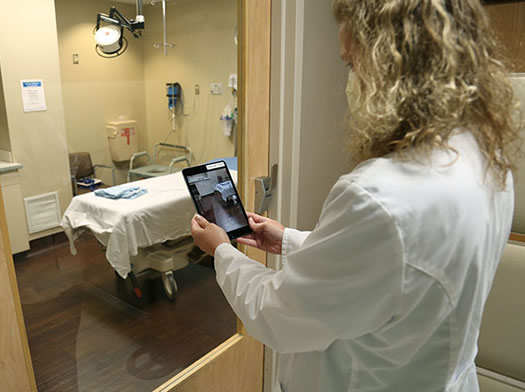
“Whenever you put a patient in an isolation room, you turn on the tablet and point it toward them, so we can turn it on and off by the home tablet, and close the door,” said Heather Whited, B.S.N., R.N., manager of emergency services at Texas Health Presbyterian Hospital Denton. “Physicians can use them instead of entering the room for an initial meeting, updates, questions and more, without any exposure.”
At Texas Health Presbyterian Hospital Dallas, physicians often use the tablets to take an initial history from patients in isolation, or to ask follow-up questions.
“The physicians really like it,” said Jennifer Hay, M.S.N., R.N., director of emergency and trauma services. “The patient can see the physician, and the physician can see them.”
Nurses also use the tablets to check on patients more often or provide updates without risking exposure, Heather and Jennifer said.
“You don’t have to get into PPE just to ask how the patient is doing or if they need anything,” Heather said. “It decreases the number of times we have to go in and out of the room.”
Although nurses and physicians needed some training to use the devices, patients don’t need any technical knowledge.
“The patient doesn’t have to touch it at all,” Jennifer said. “It’s all controlled by the care team tablets.”
Patient privacy is maintained by turning the device on and off remotely, Heather added.
“We make sure it’s all done on our end,” she said. “But to give patients their privacy, we only turn it on when needed.”
Response has been overwhelmingly positive.
“It’s going really well,” Heather said. “We’ve had all positive feedback from patients, providers and nurses. The patients really seem to understand the need for distancing, so we haven’t had any negative comments. We’re really pleased with it.”
By Robin P. Loveman • Posted April 22, 2020
