
Andres Gonzalez of Haltom City is on his feet. He’s using a walker, and has two nurses moving along with him. His halting steps just take him to the doorway of his hospital room. But he’s walking – one day after quadruple bypass surgery.
A patient at Texas Health Harris Methodist Hospital Hurst Euless Bedford and an electrician by trade, Gonzalez is part of a mobility initiative in the hospital’s Intensive Care Unit. He’s on the move for a multitude of reasons, all good for his health.
Early walking or sitting up, even for very sick ICU patients bestows huge benefits, according to studies published in the Journal of Critical Care, Intensive Care Medicine, Critical Care Medicine and Drugs.
The idea for the initiative came about when ICU nurses wanted to do a Performance Improvement project “to revitalize the unit and focus on excellence,” said Chelsea Zepeda, ICU nursing manager at Texas Health HEB.
They had seen the research, and decided mobility would be a good focus, Zepeda said.
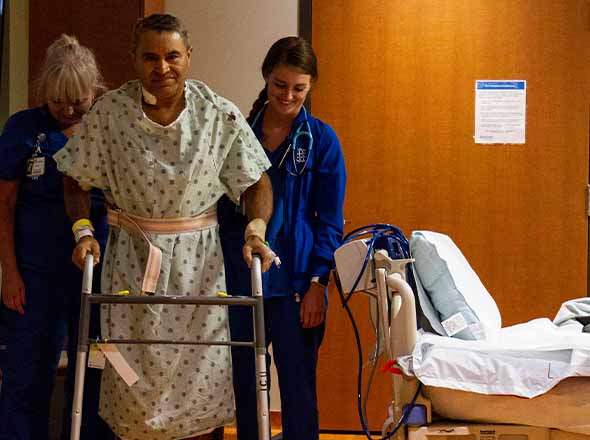
“Based on evidence-based practice and research, early mobility decreases the overall ICU length of stay, decreases oxygen requirements, decreases the amount of ICU delirium, and decreases pain,” she said.
Best of all, it helps get patients healthier faster and out of the ICU sooner, whether to a step-down unit, long-term care … or home.
“By simply decreasing the ICU length of stay, patients are at less risk for healthcare-acquired conditions, such as blood stream infections, pressure ulcers, pneumonia, and muscle atrophy due to prolonged immobility,” Zepeda said.
Her 18-bed unit has seen patient length of stay from drop from 14 days to 12 since the initiative began in December 2017.
Some of the other benefits also contribute to shorter lengths of stay.
The lung expansion that comes with even limited mobility mean patients are less likely to come down with pneumonia, Zepeda said.
Avoiding or lessening ICU delirium may have a positive effect on a patient’s long-term health. Zepeda said one study indicates that those who experience the phenomenon are 50 percent more likely to have more cognitive dysfunction later in life.
Delirium affects 80 percent of patients in the ICU, Zepeda said. The causes are uncertain, she said, but it’s believed that ICU stays – whether through medication or lack of sleep – disrupt the dopamine and serotonin receptors in the brain.
Sleep is hard to come by in the ICU, where nurses round and blood pressure is checked hourly. Beeping monitors are a fact of life.
Mobility here starts with doctors’ orders and in baby steps. Sometimes just sitting up on the edge of the bed is all a patient can handle. Others may be lifted or slid into a cardiac chair, a specially equipped chair for patients ready to be upright.
Nurses currently get all the unit’s patients up at breakfast, lunch and dinner, whether it’s just to sit up or to walk the minimum – four steps.
As Phase II of the initiative begins, physical therapists will be consulted early. The walking minimum will increase from four steps to out the door of the patient’s room. Zepeda would like to see the average length of stay drop to 10.
She said mobility in the ICU isn’t a brand-new idea, but it’s one that hasn’t been practiced in a structured way — and it hasn’t always focused on actually getting patients on their feet. A more typical procedure would be to just turn a patient a few times a day.
Patient mobility in the ICU now, Zepeda said, has gone “from a pipe dream to an expectation.”
A few minutes after his first post-surgery steps, Andres Gonzalez is on the move again, although this time he’s leaving the ICU in a wheelchair headed for a step-down unit – his recovery has gone so well so quickly he’s ready to go.
Nurse Briana Bindel, R.N., BSN, wheeled him away and returned, satisfied with her day. She’d been caring for Gonzalez since before his surgery, during his recovery – and got to help him take his first steps in the ICU.
“I had the pleasure of doing Mr. Gonzalez’s pre-op teaching, then was able to take care of him and help him recover immediately after his surgery,” she said. “One of the most fulfilling parts of my career is taking care of a patient at their most critical time, then later being able to carry on a conversation and get to know them as a person. It is rewarding to watch a patient go full circle, and Mr. Gonzalez did that in under 48 hours.”
by Judy Wiley
