
Unable to speak, tubes inserted in multiple orifices, and confused by disorienting bedside alarms and strangers around them – all with no memory of how they ended up in this situation. This is the experience for many patients in an intensive care unit (ICU).
“An episode in the ICU can be dehumanizing,” said Andrew Masica, M.D., senior vice president and chief medical officer of Reliable Health. “The loss of personal identity, control, privacy and respect compounds critical illness and can have life-changing consequences for our patients.”
To help lessen the potentially harmful effects of an ICU stay, Texas Health Resources has begun implementing the ICU Liberation Bundle. Endorsed by the Society of Critical Care Medicine, the bundle is designed to improve collaboration among care team members and standardize care processes.
“This is the right thing to do for our patients,” said Mary Robinson, Ph.D., R.N., NEA-BC, senior vice
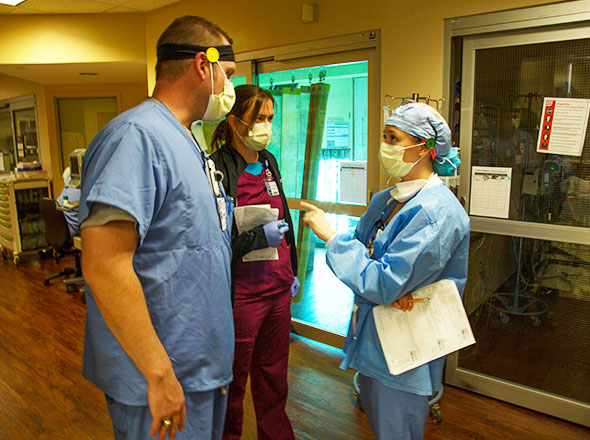
“This is the right thing to do for our patients,” said Mary Robinson, Ph.D., R.N., NEA-BC, senior vice president and chief nursing officer of Reliable Health. “Very few things we do in patient care can have as significant an impact on clinical outcomes as the ICU Liberation Bundle.”
The ICU Liberation Bundle is another way Texas Health is working to provide safe, reliable care to consumers.
“The bundle supports our efforts to become a high reliability organization and reminds all of us of the importance of standardized care processes in our work,” Robinson said.
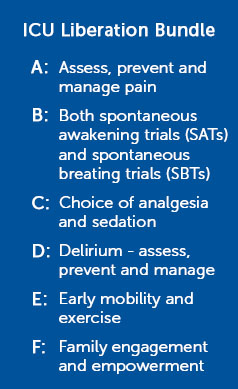
ABCDEF
The bundle consists of six elements (A-F) that form an implementation strategy for providing each of the recommendations in the PADIS (pain, agitation/sedation, delirium, immobility, sleep disruptions) guidelines for every ICU patient. Delivering the ICU Liberation Bundle requires an interdisciplinary team including nurses, respiratory therapists, physical and occupational therapist, physicians, pharmacists, informaticists, and representatives from quality and safety and the transformation office. Each hospital has a champion to help facilitate implementation of the bundle.
According to the Society of Critical Care Medicine, the bundle has been proven in multiple studies to:
- Decrease likelihood of hospital death within seven days by 68%
- Reduce delirium and coma days by 25-50%
- Reduce physical restraint use by more than 60%
- Cut ICU readmissions in half
- Reduce discharges to nursing home and rehabilitation facilities by 40%
Facilitating measure-vention
An ICU Liberation navigator in CareConnect One acts as a hub for bundle information.
“The navigator provides a very clear way to see how we are making an impact on the patient as well as on the metrics,” said Joni Padden, D.N.P., APRN, ACNS-BC, IN-BC, CPHIMS, chief nursing informatics officer.
Documentation of the bundle in CareConnect One will help facilitate measure-vention; that is, identifying care gaps in real time and making meaningful interventions while the patient is in front of the caregiver.
“Measure-vention accelerates delivery of evidence-based care to the next level of reliability,” Padden said. “You can see the data in real time that lets you know you need to take action.”
Data in CareConnect One facilitates measure-vention for all nurses.
“Whether you are in the ICU or not, you can use information in CareConnect One to make those important real-time decisions,” Padden said.
By Laura Johnson • Posted June 24, 2021
