
Seizure detection offers hope
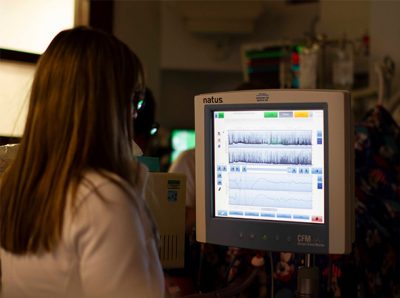
Dr. Antonio Santiago and nurse Susan LaDoux peer at a computer screen in a darkened section of the NICU at Texas Health Presbyterian Hospital Plano.
Behind the screen lies a baby in an incubator covered with a cheerful blanket. Family members come to the bedside for a little while and then go. Inside the incubator, electrodes are attached to the baby’s head, delivering information to Santiago and the nurse that will help them learn what is taking place inside the child’s brain.
Santiago, medical director of the NICU and a member of the medical staff of the hospital, and the nurse are using an aEEG, an amplitude electroencephalograph. The machine can detect seizure activity even when a baby is not visibly having one, a boon to physicians trying to assess brain injuries in tiny NICU patients who cannot describe what is happening and whose movements are naturally random
It can also offer hope to frightened parents — seizures caused by brain injury that are detected this early can be treated, which may lead to favorable outcomes, Santiago said. While the technology has been around for several decades, it has lately come into use more frequently in NICUs as research has shown how it could help.
“It can detect the state of brain activity to initiate therapy,” Santiago said. “As therapy was researched and it was documented that it could help these babies in the long run, people started using it more.”
Treatments include medication and total body cooling therapy, which can protect against further neurological damage.
The aEEG monitoring is done for “babies who have suffered an insult to the brain that can lead to developmental delays,” Santiago said.
Brain injury in a tiny infant can include hypoxic ischemic encephalopathy — a condition caused by lack of oxygen and blood to the brain before, during or after delivery — or hemorrhages in a premature infant whose tiny blood vessels are immature and unstable.
Physicians may see signs that a brain injury may have occurred, but without monitoring they have no way of confirming it.
“The clinical diagnosis of seizures in a newborn or even an infant is difficult to do because the neurological system is immature. They’re sometimes confused with normal movement. So the machine will kind of help us detect the difference between an immature nervous system and seizure activity,” Santiago said.
Seizures in very sick babies also can be difficult to detect because of sedation or paralysis.
The aEEG is a screening tool – once it confirms continuing seizure activity, for example, physicians can order a full EEG to investigate further.
“Research has shown that if there’s improvement in brain activity at a certain point, babies with hypoxic ischemic encephalopathy have better outcomes,” Santiago said. “We can communicate that with the parents.”
For example, one Harvard study showed that mortality rates were significantly reduced in cooled babies, and more of the babies who underwent cooling survived without disability.
Texas Health Plano’s NICU has had the aEEG machine for about five years, he said.
“There’s been at trend in intensive care units to say, ‘We monitor the lungs, we monitor the heart — what else can we do to monitor the brain?” Santiago said. “It’s come up in recent years as part of intensive care units monitoring the whole system instead of just a few organs.”
by Brand Experience Communication • Posted June 21, 2018
