
Community health workers stay connected to patients
Darrell Nelson, a 70-year-old Euless man with congestive heart failure, had missed two cardiac rehabilitation visits in a row after he was discharged from Texas Health Harris Methodist Hospital Hurst-Euless-Bedford.
It turned out he wanted to make his appointments but had transportation problems.
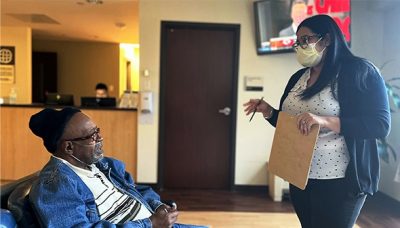
Enter Leonor Buckner-Gallegos, an on-site community health worker (CHW) at Texas Health HEB, who found a solution. Nelson began making it to the important appointments regularly, thanks to a Texas Health Community Health Improvement program that extends care beyond hospital walls.
“This is another way Texas Health is reaching into the communities we serve,” said Catherine Oliveros, Dr.PH, vice president, Community Health Improvement. “These community health workers stay in touch with uninsured and underinsured patients for six months after they leave our hospitals, if needed.”
Texas Health Harris Methodist Hospital Fort Worth, Texas Health Harris Methodist Hospital Stephenville and Texas Health Arlington Memorial Hospital each has an on-site CHW as well.
Nelson, who is on oxygen full time and walks with a cane, had been relying on his sister for rides, but she works and wasn’t always available. He’s glad to be getting the care he needs now.
The Continuum of Care program focuses on the social determinants of health by providing connections with community resources, said Caryn Paulos, senior director of Faith Community Nursing and Community Health Improvement. She is leading the program.
The social determinants of health are non-medical factors that influence health outcomes. They include access to reliable transportation, healthy foods, quality education and economic opportunities.
Perseverance and detective work
Buckner-Gallegos and her counterparts meet patients before or within 24 hours after discharge and call them within 72 hours after discharge. Within 10 to 14 days, they make a plan that includes goals and how to reach them.
In Nelson’s case, Buckner-Gallegos had a warm handoff, meaning she met him in person before he was discharged. That sets up the relationship for success.
“I’ve been checking in with him by phone and interviewed him by phone asking about his needs, his priorities, what he’s struggling with,” she said. The detective work begins once the plan is established.
She connected Nelson with an agency providing transportation, but he had problems understanding how to reserve a ride. “If there are barriers, I remove them,” she said. Once that was resolved, she also connected him with a backup ride service.
Margaret Dunbar, the CHW at Texas Health Fort Worth, recounted multiple cases full of twists and turns during a meeting with her colleagues and Paulos. For example, one of her patients couldn’t be discharged until he found shelter. She located several, but he declined to use them. Then she drove to another shelter because the phone didn’t work, only to be referred elsewhere. It turned out he was banned at that location. While Dunbar was still pursuing a solution, the patient became sicker and couldn’t be discharged.
When they’re not guiding patients, the CHWs are finding and connecting with community resources.
Slowing readmissions
Keeping patients healthier also prevents readmissions. Without rehabilitation and doctor visits after discharge, many patients with chronic diseases get worse, quickly return to hospital emergency departments and are then readmitted.
“We have had patients who have had health issues and the CHWs connected them back with caregivers,” Paulos said. “They stayed out of the hospital because someone navigated them to a care provider.”
