
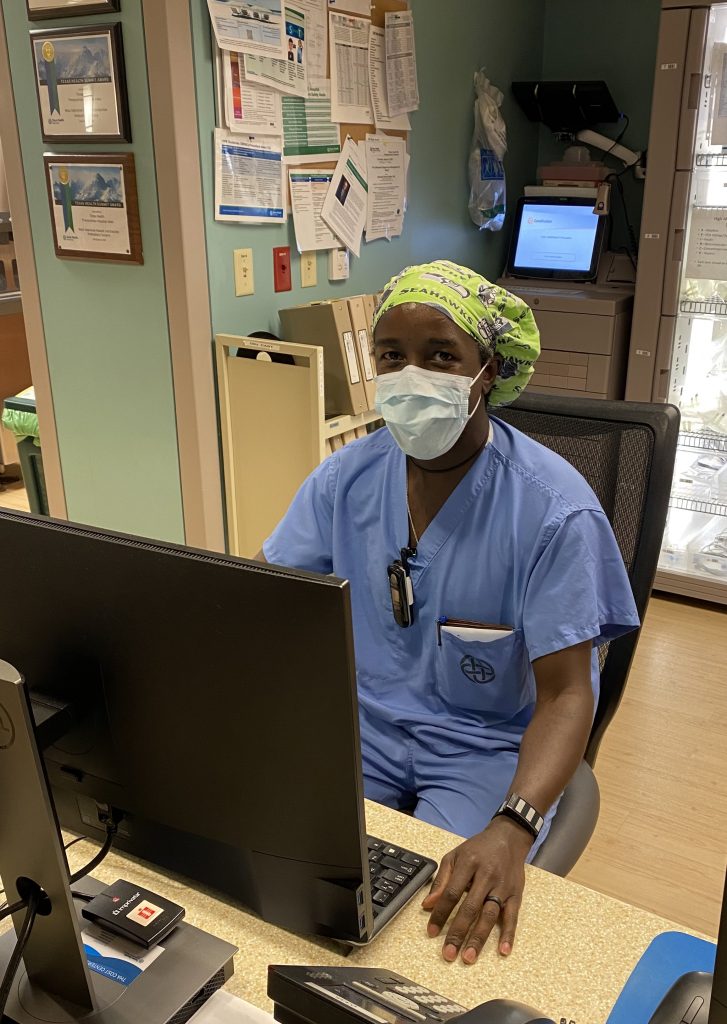
With an automotive degree under his belt, Muraya Muraguri always loved using his hands and his intellect to fix things. But after Muraguri’s former automotive shop supervisor encouraged him to use his “people skills and personality to care for people in need,” he found his calling in the field of nursing.
In translation, Muraya Muraguri, means “the tall one,” and “the prophet,” and originates from the Kikuyu tribe in Kenya. Standing seven inches shy of six feet, Muraguri said his parents often told him his name didn’t reflect his height, but more so his impressive achievements. That support from a nurturing family led him to leave Kenya as a teenager and move to the U.S. The end result was his discovery of a fulfilling nursing career at Texas Health Resources.
For six years, Muraguri, M.S.N., R.N., has been with Texas Health Presbyterian Hospital Allen. Serving as the hospital’s Orthopedic Spine Program coordinator for more than five years, Muraguri, just this year, became one of Texas Health Allen’s four Quality Improvement nurses.
Learn more about Muraguri and what led him to Texas Health Resources:
What did you want to be as a kid, and how did you ultimately choose your career?
I wanted to join the military when I was younger, but eventually gravitated toward the automotive field. Interestingly, the transition from automotive to health care was seamless. I realized that much of how an automobile works is modeled after the human body.
What was something surprising your learned during the pandemic?
The pandemic emphasized that it’s not a marathon, it’s an ultra-marathon. The best we can do is accept that change will happen, adapt, and move on. Above all else, we must take care of ourselves so we can make it through the finish line.
I have had the good fortune of seeing patients who were very ill recover and leave the hospital better than when they came in. Knowing that we have lost people close to us over the last year, I am reminded that each day we impart something to those we meet.
One patient in an isolation room remembered me waving at her through the glass separating us as she battled COVID-19. To hear the hope that a simple gesture can give in trying times keeps me grounded and reminds me of why I became a nurse.
What’s your favorite part of your job, and what is the biggest challenge?
I get to look at opportunities for change and find different ways to achieve them. Solving problems and imparting that knowledge onto others is a big part of what I love about my job. I work closely with multidisciplinary teams to ensure goals are met through process improvement.
The biggest challenge or opportunity is to avoid frustration when trying to teach others. Everyone has a journey that is different from my own, and I just need to meet them where they are.
What’s something people would be surprised to know about you?
I love working on anything mechanical; and diagnosing and troubleshooting issues have turned into a blessing over the years. I try to be smarter than the bolt, meaning when things don’t go as planned, I look at things differently to make sure the job gets done.
In my spare time, I enjoy fishing, long-distance running, and spending time with my wife and two daughters.
How do you do your life’s best work at Texas Health?
I stand on the shoulders of those who came before me, which allows me to lift those around me. I strive to learn each day, and in so doing, I teach others by passing on the legacy of selflessness and collaborative knowledge.
