
Two nurses and a patient care technician at Texas Health Arlington Memorial Hospital decided to go above and beyond to help their patients, as they saw their COVID-19 unit fill with many who spoke only Spanish.
Josh Ramos, B.S.N., R.N., PCT Luz Garcia and Xochitl Guerrero, B.S.N., R.N., took the tests to become Qualified Bilingual Interpreters.
“We do see a lot of the Hispanic population being affected by COVID and many of them are not able to speak English,” Garcia said. “Since they’re not allowed to have any visitors, it’s very important because we are all they have.”
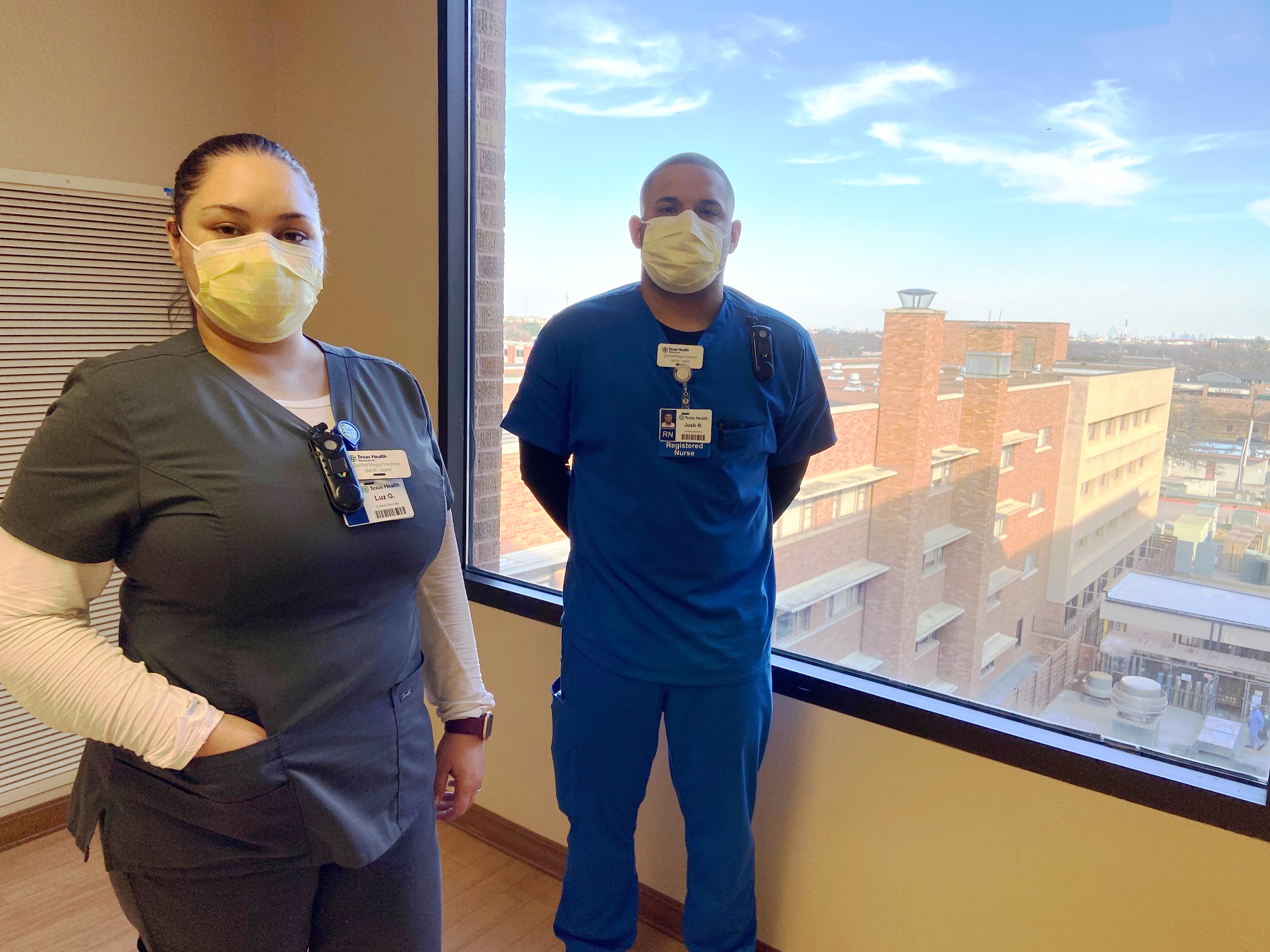
The three are in a med-surg unit that has been all-COVID-19 since March. Ramos and Garcia, below, estimated that at times more than half their COVID-19 positive patients are Hispanic, and many of those don’t speak English.
Garcia remembers walking into a patient’s room and asking if everything was going well for him. He said yes, but as she took his vitals and talked to him some more in Spanish, he finally said, “I don’t understand anything.”
She explained in Spanish what the numbers meant — blood pressure, temperature, oxygen level. “It’s just sad, the fact that they don’t know anything about what’s going on. They know they’re sick. That’s it.”
Guerrero, below, said she’s been interested in becoming an interpreter since nursing school.
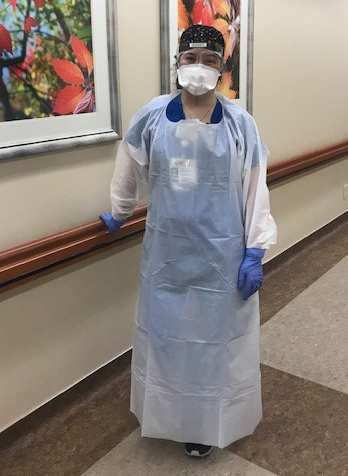
“As I was growing up I had to be the interpreter for my parents, who didn’t speak English for the majority of my childhood,” she said. “Especially now with COVID, where family isn’t allowed to visit, it just really emphasized the need for patients to have someone there who could understand.”
Shonna Bracco, D.N.P., R.N., NEA-BC, chief nursing officer at the hospital, said their contribution to patient care is important.
“As challenging as it’s been during the pandemic, these three stepped up and did extra work in the name of excellent patient care,” she said. “I’m so proud of all our caregivers for their unflagging work as more COVID-19 patients continue to pour in.”
Testing and training
Qualified Bilingual Interpreters are tested and trained, said Robin Gordon, Language Services manager.
“By Joint Commission standards and by federal law, a person interpreting medical vocabulary must have their language skillstested and must be trained to provide that interpretation,” she said.
Gordon said 415 employees representing 21 languages have completed the program.
Employees can apply, take a pre-test and take the main examination over the phone. Ramos said the main exam was a conversation in Spanish. After a two-hour orientation, they are qualified.
The whole process took about two weeks, he said, and it was easy for him as his first language was Spanish. Medical terminology was not a problem because he attended nursing school in Puerto Rico and some of his classes were taught in Spanish.
Garcia, who was born in Mexico and lived there until she was 15, said she had to do a little research for some medical terms but was easily able to pass the tests.
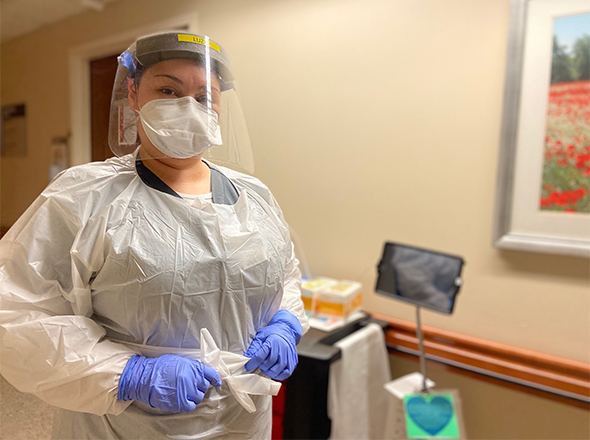
Their supervisor, nurse manager Julie Etzelmiller, B.S.N., RN-BC, said she encourages her staff to do something above and beyond every year, and this is what the three of them chose.
Etzelmiller said their interpretation skills clearly help patients.
“It’s a huge comfort and it gives those patients peace of mind. It’s very scary and they’ve been having to dial into the video. It’s OK, but not the same as having your nurse or your PCT able to speak with you in your first language,” she said. “They feel they’ve made an impact and I’ve seen it, too.”
By Judy Wiley • Posted January 26, 2021
