
Responding to the Worst Day in Someone’s Life
Five Questions with Greg Terry, B.S.N., R.N.
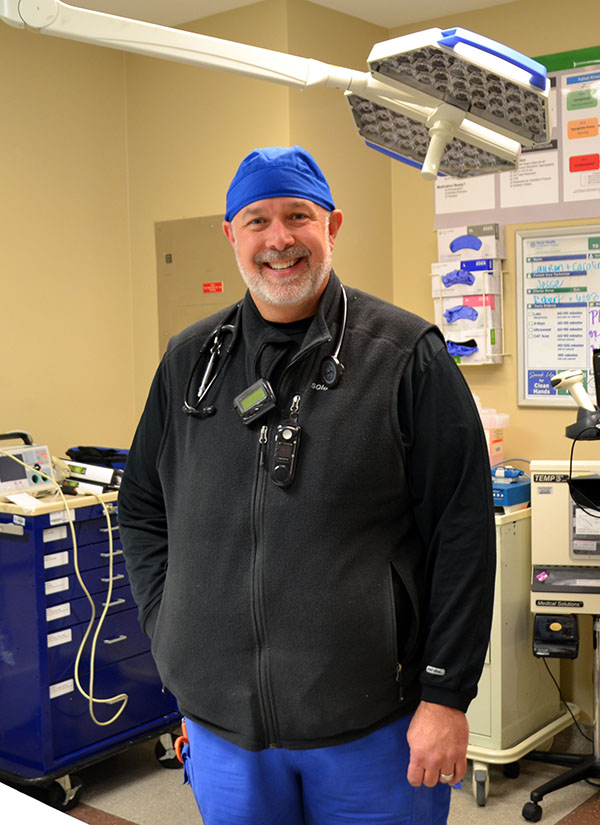
Greg Terry, B.S.N., R.N., has been a trauma resource nurse at Texas Health Presbyterian Hospital Dallas since 2016.
His job requires clinical excellence, attention to detail, and a deep well of compassion for patients and families going through life-changing events.
What did you want to be as a kid and how did you ultimately choose your career/job?
As a kid I thought I wanted to be a paleontologist due to my total obsession with dinosaurs.
However, I was an accountant for 15 years before I went to nursing school. That decision was made about halfway through my wife’s 3-year illness, where I was doing lots of her care at home. It was all her idea. She knew I was unhappy in my job and just said to me out of the blue, “Do you think you’d want to be a nurse?” I was blown away and took a week to think, pray and research. At the end of that week I took a leap of faith, quit my job and enrolled in nursing school. That was 15 years ago, and the rest, as they say, is history.
What is a typical workday like?
As trauma nurse clinicians, our primary responsibility is to respond to trauma activations in the Emergency Department. We function as team leaders of sorts in those activations, coordinating the appropriate care for those trauma patients. We then follow all patients that are admitted on our call days with traumatic injuries throughout their stay here at Texas Health Dallas. We are responsible for the extraction of data from the patient charts that are required by the state and national accrediting bodies for trauma certification. We are involved in all aspects of trauma education, process improvement, community outreach and numerous other areas related to trauma and trauma prevention.
What is the biggest challenge of your work?
It can be very challenging being intimately involved in what frequently is the worst day of someone’s life. I hug families and cry with them. I’ve gone to funerals, but also celebrated unexpected recoveries. At the end of the day we give 110 percent, realize that their trauma isn’t our trauma, and go home and hug the family just a little tighter.
Multi-system trauma care is an incredibly challenging field. You have to be prepared for all varieties of trauma, such as vehicle collisions, shootings, stabbings, falls, industrial accidents and more. We are truly Jacks (and Jills) of all trades, without the luxury of being masters of none. Your garden-variety chronic medical conditions may greatly impact our care of you after a traumatic event. We have to always be on our toes!
What do you like most about being an employee at Texas Health?
I have worked in a number of hospitals and systems in the Metroplex, and I can say without hesitation that this has been the best of all of them. It is so encouraging to see so many incredibly long-term nurses here at Texas Health Dallas. I feel that as staff we are deeply involved in process improvement, and our participation is encouraged to a greater extent than I’ve experienced previously.
What do you do when you’re not at work?
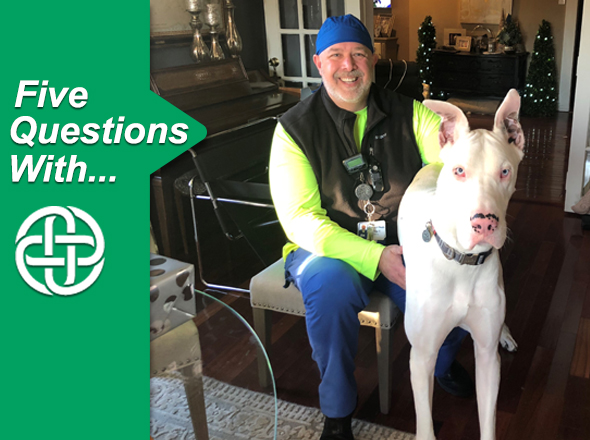
I’ve been married for 26 years, am father to one son who is soon to graduate from SMU with his master’s in finance, and I have an awesome 145-pound Great Dane named Ares. When I’m not working, or at the park with Ares, I love to travel. We just came back from Cuba a few months ago and have a trip planned in June that will include St. Petersburg, Russia!
By Larry DeBoever • Posted February 26, 2019
