
To strengthen their skills in advancing change and improving patient outcomes, nurses at Texas Health Harris Methodist Hospital Southwest Fort Worth recently completed a new Evidence-Based Practice Mentorship program. The program consisted of six sessions where participants were paired with a mentor and learned the steps for creating an evidence-based practice project.
“We designed the program to help front-line nurses learn evidence-based practice skills that they can use in improving patient care and organizational outcomes,” said Kimberly Williams, M.S.N., RNC-MNN, NEA-BC program manager, Clinical Excellence. “We’re proud to offer a fast-track program that features support from mentors every step of the way.”
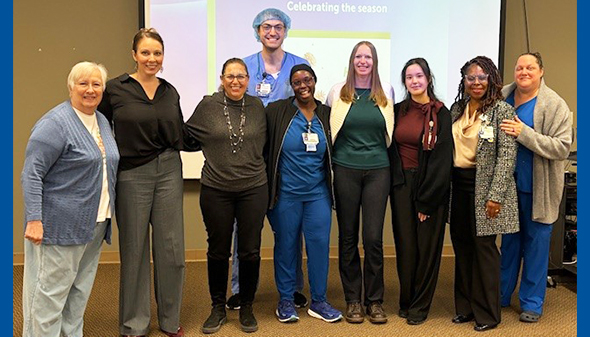
Yvonne Dhaure, B.S.N., R.N., CCRN, saw the program as an opportunity for professional growth.
“I wanted to engage in something challenging, so when I heard about the program, I was excited to jump in,” she said.
Stephanie Van Keer, B.S.N., R.N., PCCN, saw the program as an opportunity to advance a project in which she was already interested.
“I had just finished a poster presentation on my topic, and the mentorship program was great motivation to keep working on and strengthening the project,” she said.
Shara Gray, a Research, Innovation and New Knowledge Council member and a former TCU Evidence-Based Practice Fellow, served as a mentor in the program.
“What continues to inspire me about evidence-based practice is how it empowers nurses to drive positive change, directly impacting patient outcomes and improving recovery,” said Gray, B.S.N., R.N., CMSRN, ONC, Texas Health Southwest/Clearfork.
While Texas Health’s Health Science Fellowship focuses on teaching clinicians how to conduct research, the Evidence-Based Practice Mentorship program focuses on learning how to translate evidence into practice. The program is similar to the TCU Evidence-Based Practice Fellowship but is a rapid-cycle process.
“We are committed to advancing a culture of innovation through evidence-based practice, and this mentorship is another resource for nurses to get the support and information they need to drive innovations in care,” said Julie Balluck, D.N.P., R.N., NEA-BC, chief nurse executive.
Participants in the program learn the framework for developing a PICO (Problem, Intervention, Comparison, Outcome) question and how to translate literature into nursing practice using the Iowa Model. They are partnered with a mentor throughout their project development.
Dhaure developed the PICO question, “In critically ill patients in the ICU, how does the Jackson/Cubbin Scale compare to the Braden Scale in pressure injury risk assessment and the development of a specific care plan?” With guidance from the ICU manager, the unit created a project based on the question. A pilot of the program began in January and data will continue to be collected through March and will be compiled in April.
Dhaure is proud of what she accomplished through the program and project.
“Learning this process is something I could not have experienced anywhere else, and I am forever grateful for the opportunity,” she said. “I learned that I can do anything if I put my mind to it; there are no limits to learning.”
Developed by Williams and Kathy Baldwin, Ph.D., R.N., ACNS-BC, AGPCNP-BC, FCNSI, FAAN, nurse scientist, the mentorship was a pilot program designed to be replicated at other interested Texas Health hospitals.
“Evidence-based practice empowers nurses to make meaningful contributions not only to patient care but also to our unit, our entity and our organization,” said Gray. “It is what sets us apart and helps us provide the best possible care.”
published
